Showing posts with label Dalag (Haruan). Show all posts

Wednesday, March 22, 2017

Heavy Cover Fishing for Snakeheads 101

I was introduced to Snakehead fishing around the first half of 2008 by none other than Bong Chua --  our Snakehead expert and the man who started snakehead fishing using lures in PH,. It was during that time when I started lurking a fishing forum called FilipinoAnglers.org and that's where I first learned that you can actually catch snakeheads using lures. The most famous lure back then was Bong's hand-made spinner-bait. The lure caught snakeheads of all sizes. Heck, it even caught other species such as Barramundi, tilapia, and threadfin herring. Wanting to learn about snakehead fishing on lures from no other than the best, I pm'd Bong to buy some of his lures. I didn't realize that he's my neighbor and he lives just a block away. That's when I started hanging out with him and learned about the snakehead fishing techniques and lures.

Back then, I mostly caught snakeheads in open water using Bong's spinners. Bong on the other hand, was also able to catch them using solid body frogs. I wanted to try them but he had no spares and not a single tackle shop in the country sells snakehead lures let alone frogs. The frogs he used were a couple of really old Harrison Hoge Superior Frogs. I think they are now called Panther Martin Superior frogs. From the looks of the lures he was using, (the legs had been glued, replaced, and repaired for god knows how long) they were probably at least 30 years old.  Although old and tattered, the snakeheads loved them. The topwater explosion when a snakehead lunges at them was unforgettable. Because the frogs were not available anywhere in the country, my obsession about these lures became worse. Ordering overseas was a pain at that time.
Harrison Hoge Superior Frog (pic borrowed from Bassmaster.com)

Sometime a bit later, online lure shops started offering International shipping and that changed everything. We found what frogs that were available online and how to order them. I believe I ordered and tried whatever was available online at that time.


Whenever a new set of frogs arrive, Bong and I would meet in our secret-but-not-so-secret spot called 'kangkungan". It's a stinky swampland near our village. Although it was full of vegetation in very little water, it has lots of snakeheads. The only game to be had there was topwater fishing using weedless frogs. After months of testing different frogs, I was convinced that were only 2 that really delivered -- Boze Sumo frogs and Spro Bronzeye frogs. The rest were pretty much inferior compared to these 2. To be honest, I stopped buying other brands. I got a few other brands but they rarely catch anything.

October 2008, snakeheads from the Kangkungan
Aside from learning what I can about the new frogs, I tried some of the the rods, reels, lines, and leaders that were perfect for that type of fishing. From the lowly kangkungan, we tried other spots nearby. Because of the new frogs, we were able to fish the heaviest swamps that you can find and we were able to catch the snakeheads. With the the help of FilipinoAnglers online forum, dalag fishing became popular. A lot of people would fish for snakeheads using spinners and frogs all over the country. Different groups even organized a few tournaments in honor of the sport. It was a blast and a lot of people were into it.

Around three or four years ago, snakehead fishing lost it popularity. Perhaps when saltwater shore fishing and UL fishing became a big trend. I think it also coincided with the rise of Facebook and the slow downfall of online forums in the country. Because of that, I sold most of my snakehead rods and reels and lures.

Last year, the game became a hit once again thanks to our friends from HCG Pampanga. It is now called Heavy Cover Game, inspired by Japanese Heavy Cover anglers for Northern Snakeheads. Almost a decade after, more young anglers are taking a liking to fishing for snakeheads. Fishing tournaments were held and more are being planned in the future. I am so happy that more angler are picking up the game and I even started joining a couple tournaments (with great success if I may add ;-)) and started buying rods and lures once again. I hope the trend continues and we keep on catching and releasing them so we can still enjoy them in the future.

After 9 years of fishing for snakeheads, here are some of the gear that would I recommend  if you want to get started.

Rods - 6'6" up to 8' Heavy baitcasting rods. Longer if you frequently fish relatively open spaces. Shorter for tight spaces. My preference is at least 7' rods with 12-30lb rating. Why heavy? Heavy rods will make sure that those big hooks from frogs will penetrate the tough haw of snakeheads -- specially the big ones. It is also needed to deliver the muscle to pull the snakeheads out of the weeds when hooked. This won't force you to wade into the water when you hook a big one. Trust me, I have had  a few close calls when wading -- I didn't realize that the water was deep or the mud was really thick. Drowning is always a possibility when fishing swamps/marshes. Make sure the rod is light enough -- 130g-150g if you can find one. Lighter rods allow you to fish longer and cast more frequently. I prefer a rod with Fuji ECS reel seat when using low profile reels or Fuji ACS if using round reels.

After wading in neck deep water, I was able to land this beast. If I had a heavier setup, I probably would be able to land it without wading.

Reel - Baitcasting setup is what I recommend. It allows you to cast accurately and has more power when pulling out those snakeheads from heavy cover. Low profile or round reels in the 100 size is enough. 200 size is also ok but the smaller and lighter the better. You don't need a lot of line anyway. Lighter means more time casting. A reel with a speed is 6.3:1 up to 7.9:1 is recommended. Too fast and it loses torque. Too slow and it will take a lot of cranking to get the frog back for the next cast.

Ryoga 2020HL on a 7'6" Daiwa Flippin Stick

Line
- Definitely braid! X8 (8-strand) is nice but not necessary. X4 (4-strand) should be adequate. The problem with braid in heavy cover is that it frays easily because of the smaller strands. This means you need to trim the braid every so often to remove the frayed sections. Otherwise, you will lose those precious frogs. One solution to minimize the length of frayed braid is to use longer shock leaders. A meter to meter and a half is ok. Tip: The make sure that the knot between the leader and main line does not reach the reel's line guide when in casting position. This will prevent backlash during casting.


Leaders - I recommend mono shock leaders. 30lbs for regular vegetation such as kangkong (water spinach), lilies, or lotus. Use 40lbs if there are sharp grasses and sticks. Flouro is ok but they are expensive. Besides, there is no need to hide the leader from the fish when your lures are on top water. For Philippine-based anglers -- check out Goodcatch Fishing's bulk Sufix Superior Shock leaders. They are in rolls (not in spools) and they come in 100m lengths. The spool are making the line more expensive. Just buy the unspooled line and spool them on used spools. Anyway, Sufix Superior shock leaders in bulk are cheap and reliable. I have been using them for god knows how long and they never failed me. In Japan, they don't use leaders. They tie their frogs directly to the braid main line. Probably because braid is cheap in Japan. :-).

Lures - Spro Bronzeye 65. Buy a Spro if you don't mind spending the extra coin and select the size 65 if you are only after the big ones and don't want the small snakeheads to bite. Get a Spro Bronzeye 60 if you don't care what size of snakehead bites. Boze Sumo frog if you want a cheap frog that performs like a Spro. It only has one size and weight-- same as a Spro 65. You are lucky if you can find a Boze Sumo frog somewhere. I think they are out of the market already. (Dear Boze Sumo manufacturers, I hope you are reading this. Please continue to make them and sell them in Asia. PLEASE! Forget BASS, they are candies for Snakeheads!). Hard bodied frogs from Thailand are also ok but in my experience, they are more suited in light cover or open water. They snag often and then hookup ratio is not that great. A snakehead needs to hit exactly the hook to get a solid hookup unlike hollow-bodied frogs. When you do get a hookup, the weed-guard would open up and snag more weeds making it hard to land the fish.

Others - I stopped using Snap Swivels or other swivels. I just tie the leader directly to the lure using enhanced Uni-knot or clinch knot. I have had occasions when snaps would give way when the snakehead rolls after they are hooked. When a snap gets twisted, it will eventually fail. In addition to that, snaps will snag on vegetation. When they snag on a tough grass or stick, they will fail. Get a decent waders. Hip waders with rubber boots will do. It protects your leg from creepy crawlies (bugs, snails, snakes, and worms) and keep your feet dry. Also, don't forget a decent polarized eyewear. It protects you eyes from the sun and roque lures. Happened to me once or twice. When setting the hook, the snakehead spits out the frog and it came flying back to my face. The eyeglass saved my eyes from a lot of pain. Knots? main line to leader -- try to learn how to tie an Aussie FG knot. It is faster to make and does not snag on vegetation. Lure to leader: enhanced Uni or Clinch.

The 60lb snap gave way when the snakehead rolled after hook up.


Basic Techniques --  Learn to fan-cast! It will allow you to cover more water. Fan-cast at least thrice before moving to another spot. When there is a strike, I always count 1-2 seconds before I set the hook. Faster and you will not be able to set the hook properly. Slower and you will allow the snakehead to dive in deep cover. Tip: Snakeheads seems to start feeding when the sun is up and the temp is a bit higher.  This means it is not necessary to fish really early. (This does not apply to Tomans). Also, monster snakeheads seem to feed just before dark. :-)


My goal right now is to find the perfect replacement for my last 2 Boze Sumo frogs and my last Spro frog that I lost during the last tournament a couple of weeks ago. If you have something in mind, let me know! So, go out there! Fish and release!


Sunday, January 11, 2015

Studying finesse jigheads and softplastics at the School of Fish

Finesse style soft plastics has always intrigued me. Whenever there's a chance, I always check out Youtube videos from Australia about tiny soft plastics on jigheads. They use  tiny jigheads with 1-2-inch soft plastics to catch bream and flatheads. After getting myself a light tackle combo, I promised myself that I will try this on local bakoko and flatties. 

A  months ago, I collected a few jigheads. Some are pasalubong from friends and a few from local stores. They were Java sticks, Charley Brewer's slider, 1.5inch Powerbaits and other soft tails that I think were suited for the application. I didn't want to go overboard and start spending a lot on these plastics unless I have tested them. Anyhow, I got the gear and collected a few baits and the only thing remaining is to try them in our local waters. I know that juvenile groupers love them but I was hoping to try them on bakoko, flatties, buwan-buwan, and other fresh and brackish fishes.


I initially wanted to try this in Pampanga Delta but the area was ruined after the recent typhoons. The river delta has been heavily silted and the area is now so shallow and layered with thick mud. And if that wasn't bad enough, I broke one of my light rods before I could use it,

I got a replacement rod recently and to resume my plans, I headed to Irving's school of fish to learn to work these finesse jigheads and tiny plastics. On the first drop using a 3-gram jig and a 1.5 powerbait, one of the red tilapias gave first blood. Not bad. A tilapia was fooled by hopping the jig at the bottom.

I threw a Java stick and had a solid hookup. It ran for a few meters but the hook came off. My guess it that a dalag fancied the bait. I casted again on the same spot and got another hookup. I was right, it as a dalag.
I had a few more strikes but none connected. i figured they were small barras or tilapias that kept pulling the plastic from the hook. I switched to a green swimbait and used a heavier jig, casted in the middle and felt like my lure snagged after a few retrieves. I was trying to free the snag when something suddenly pulled drag. I thought it was a bigger barra. It turned out that it was a big mama tilapia. Almost a kilo.  I thought to myself that this finesse jig/plastic is turning out effective in SOF.

Just before 1pm, I got another solid hookup. It was a barra. I think it was more or less a kilo in weight. Just before I can land it, the hook unbuttoned. Casted again on the same spot got another barra. It's a bit smaller but fun on light tackle nonetheless.


After this  fun outing, I decided to look for more plastics to add in my arsenal. 

Tuesday, September 18, 2012

To Snap or not to Snap: Snap swivels when Lure Fishing

I regularly use snap swivels when lure fishing. Retying every time I change a lure is too much work for me. This is specially true when I am still trying to figure out what lure is getting hit. I have to try different lures after a few casts --  wtd, poppers, spinners, suspending jerkbaits, floating jerkbaits, cranks, and so on until I get that perfect lure that fishes are after. Cutting and retying means you lose time and also leaders.

This is where a snap swivel comes in handy. Just tie on a snap and switching lures is easy. I have tried a few lure snaps and the latest was this 56lb test Ten Mouth Snap swivel. A Japanese snap, as I was told. It was ok for a while. I have been using it on fresh water, saltwater, and there were no major issues as far as I can remember.

But lately, when I started using heavier main line -- 35lbs and then lately, 50lbs, it started to fail.

Last week, I fished for snakeheads up North using a slightly heavy rod. I loaded the reel with 35lbs and for a while it was ok.


Later in the day, I got bit by a biggie. Probably 1.5 kg. When I was trying to muscle the fish to the bank, it rolled and was able to escape. The frog  separated from the main line. Luckily, the frog floats and I was able to retrieve it. Upon inspection, the snap twisted and opened up.

Then just last weekend, it happened again. I went to a nearby pond to test my heavy saltwater combo. 50lb braid on a 7'6" 17-30lb Flippin Stick. At first, the snap held up ok after a decent sized fish. Then I tied on a bigger sized frog to see how far the combo can cast. Casted really far with the frog. Twitched it a bit and then something bit. I set the hook and it was a solid contact. I knew instantly that it was a Toman (Giant Snakehead). A short run then my line flew back to my face. Lost my new frog because the snap snapped.


So, with these failures, I decided to stop using snaps when lure fishing. Back to Rapala knot, improved clinch, or uni knot. Not only will I save my lures, I will also save some cash. These snaps are not cheap.

Tuesday, July 31, 2012

Trying out a Daiwa Ryoga 2020HL

I had been aching to try this reel for my saltwater fishing needs. After my recent tussle with a suspected Black Bass or New Guinea Bass, my desire to get this reel was even more unbearable.

Then, a few weeks back, it happened. I was finally able to get a Ryoga 2020HL. My first reaction after receiving it? Oh boy, it's a tank!
It's a no-nonsense work horse of a reel. It looks like it's built for muscle fishing, rough and tough, but when you crank it, it's unbelievably smooth and the drag is outstanding. It has a clicker so when a fish runs, you can hear an audible clicking sound similar to a spinning reel. With 12CRBB, a sealed drag, and machined frame and side plates, it's worth every penny spent. 

I immediately spooled it with 35lb varivas and tied on a puny 20lb mono for a leader. I realized I have no leader heavier than 20 and I still don't have a matching rod. Heck, even so, I went out to try a few casts and feel how this machine stacks up against my other reels. No salt spot nearby so I had to make do with an old haruan (dalag) spot. 


I love the way it casts. It's actually better casting than my Bay Casting Special or my Zillion. It's probably the RCS spool which makes it a awesome casting machine. The power is also amazing. I was able to winch a few haruans from heavy vegetation without any problems. The reel looks bulky but when you grip it, it's actually comfortable to hold, cast, and work my lures with.

Technically, it's an inshore reel and it's a no contest when used on snakeheads. Perhaps when a Toman or a Black bass is on the other end of the line, it will probably show how powerful the reel is. 

For my next project, I need to get a heavy flipping and pitching rod in the 15-30lb class, probably 7'6" and can handle up to 3 ounces of lure. I sure hope it balances well with this Ryoga 2020HL. I am not really going to do flipping and pitching for bass (well, maybe I would if I have a chance to go to Pantabangan or Lumot). Instead, I am planning to use this for light popping, heavy swimbaits, spoons/jigs, and even live bait, while on a kayak.

Then maybe a little later, a nice light jigging/madai rod that matches this reel. Something I can use while on a kayak or when a banca.

Monday, July 2, 2012

Some more Daiwa Zillion Upgrades and a few more Dalag (Haruan/Snakehead)


I'm almost finished upgrading my Daiwa Zillion PLA Crazy Cranker. Last time, I got a 6.3 gear and pinion as secondary gear set as the all-purpose gear for top water fishing. I can still use the 4.9 gear for heavy cranking and heavy spinners or for bottom bouncing.

Last month, I ordered a Daiwa Aggrest swept handle, a set of Carbontex for Daiwa Zillion, and a set of Daiwa Wormgear upgrade from tackletrap.com. It was also a perfect timing because Kenny, our generous angler friend from Canada sent me some stainless steel handle bearings and Ceramic bearings for Daiwa Zillions.


All in all, below are the upgrades for the Zillion Crazy Cranker:

1. 6.3 Gear and Pinion
2. Carbontex Drag Washer
3. Worm Gear Bearing
4. Aggrest Swept Handle
5. 4-bearing Paddles

After the upgrade, my Zillion is now 12-bearing reel (stock reel has only 6-bearings). It feels smoother when cranking than it was before.

The next upgrade is to install the Ceramic bearings that I got from Kenny (after I find a spool pin remover) and some cork handles.

I went out yesterday and tested the reel on Dalag (Haruan). Got myself 4 nice sized snakeheads. All were caught, photographed, and released.


Go to Daiwa Zillion: Upgrading the Gear and Pinion plus Drag Washer

Monday, June 25, 2012

Dalag (Haruan/Snakehead) Fishing Again

My cousin Bulador and I did some fishing over the weekend. Originally, we planned to fish salt from shore. We started as early as 5:30am using lures and different live and dead baits. After almost four hours and three different spots, we did not get a single bite. It's pretty obvious that the spots were overfished.

I recalled that we passed by some flooded ponds on our way to the salt spots. Without any hope of catching anything from shore fishing, we decided to go dalag fishing instead. Lots of rains in the past weeks and I hoped that the haruans would be active. It's a good thing that I always bring haruan lures whenever I go salt fishing.You never know if there's a good dalag (haruan) infested water near by.

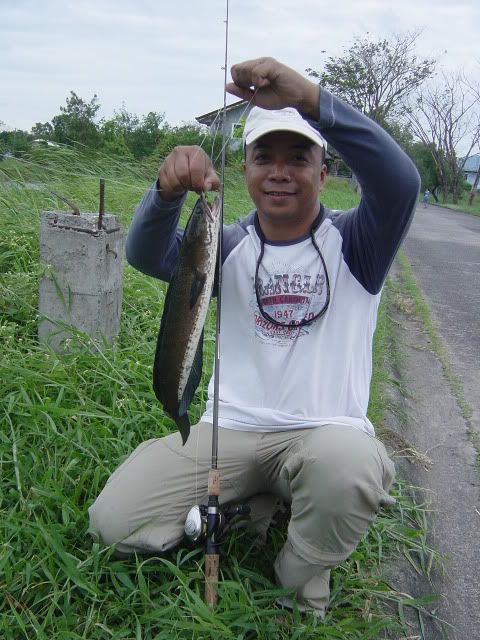
True enough, dalags (haruan) did not disappoint. We caught 8 in less than 2 hours. Bulador caught 2 while I got 6. The last fish I caught as over 1kg. My heavy casting rod was flawless in it's hook setting power.


An old man who was riding a bike noticed me while I was landing a fish and decided to stop to observe. When I unhooked the fish, took a picture, and released the fish back into the water, he almost fell off his bike in disbelief. "Bakit mo pinakawalan??" (Why in the world did you let it go?) screamed the old man. I politely said "Para dumani pa". (So that they will be able to reproduce.) Scratching his head, he insisted that I just give him the fish if I caught one. I said yes politely while I stealthily moved to another spot. The old man  still followed me at first. When I kept on moving and after a few cast, I think he got tired and left me alone. After he left, I caught and released two more. :-0

All fishes were released after their pictures were taken.


Monday, June 18, 2012

Father's Day My Time - Dalag (Haruan/Snakehead) Time

It has been a while since I did some Haruan fishing. I tried haruan fishing in Zambales last summer but the water had dried up and there were not much haruans anymore. We did some fishing in ANP a few days back but we only got a few bangus (milkfish) on light tackle. Although bangus was really fun on 6lb line, the feeling of a haruan strike on topwater is much more exciting.

Luckily, a few weeks ago, PAGASA declared that summer has officially ended. True enough, the rains started pouring almost every day. Ponds and marshes started to fill with water once more and haruans started to become active. On our way to ANP last Sunday – for a father’s day my-time-fish-time, we passed by a few flooded areas and did some haruan exploration. The wind was a bit strong and it was constantly raining all the time. Still, we decided to stop for a while to explore the waters. I did not bring a top water rod because the original plan was to check out ANP’s barra using jerkbaits. Instead of using frogs, I used my trusted spinner to check for haruan presence. I could not believe my luck. At my first cast and at the first crank, a smallish haruan struck my lure. I gave the rod a light hook set and landed my first fish. An old man saw me landing the fish and was about to come near me. I feared that he will ask for the fish so I released it back into the water without taking any photo.

I was convinced that haruans are already active. I took out my old battered frog and casted away using a jerkbait rod. It was really frustrating at first. So many strikes but I just can’t hook them up. The rod (a repaired Fenwick HMG) was just too soft to get a proper hook set. After the sixth fish that I lost due to poor hook set, I stopped counting. To compensate, I tightened my drag further and decided to give a couple of pump when there's a strike to ensure that the hooks would penetrate the haruan's jaw. I still lost a few fishes but I managed to land four.

The last one was above one kilo. It managed to destroy my old frog by chewing it inside out, removing the hook from the body and flipping the hook over. The hook retainer almost pulled out through the hook barb. Amazing.

Image

Image

Image

Bong’s experience, on the other hand, was not so good compared to mine. His rod was softer than what I was using. He kept on getting strikes but was not able get a proper hook set. In the end, he was not able to land any.

A real frog rod or a top water rod is really important specially if the target fish have tough jaws that need strong hook sets.

After I lost my old battle-scarred frog to a tree, we decided not to proceed to ANP and called it a day instead – just in time for a father’s day treat from my kids.

Tuesday, December 13, 2011

My Small Piece of Heaven

Last weekend, me and my family went to my wife's hometown to visit her ailing grandmother. We hurriedly left very early Saturday and arrived at around 10am. My wife's grandma is 97 and everyone adores her. A few days ago she suffered a stroke. Two to be exact. Her previously lively demeanor was gone after those episodes. Seeing her bedridden and unable to walk nor talk really made everyone sad.

One thing I really love about her is that she absolutely enjoys it every time I come home with a fresh fish for her. As soon as I arrive home, I go straight to her room to show my prized catch for the day. Mostly, pargo (Mangrove Jacks), a few kitoks (Jack Crevalle), and an occasional dalag (haruan) for her pesa.

This weekend, she barely recognizes everyone and hoping to show her some of my catch wasn't really possible anymore. 

A couple of weeks back, I had to rush to my home province because my father was taken to the hospital because of an almost stroke-like episode. I stayed in the provincial hospital for a week. Once he was strong enough to travel, I took him to Manila for further tests, he again stayed for a few days in the hospital. It was a stressful event. After he got out of the hospital, it was my wife's grandma who was rushed to the hospital. It was indeed a stressful time.

I could not bear see her at that state. It just sucks the life out of me. I had to detox and flush out the stress that was building inside me. I went out that same afternoon and tried to fish for haruan. My goal was "detox" and at the same time catch a couple for her possible last pesa on earth before moving on.

Aside from myself, there was a really thin lady who was also fishing the marsh. I saw her struggling to catch something. Her long thin bamboo pole snagged on a kangkong root and snapped in two. I can see from afar that she was, like me, was stressed out and almost losing hope.

I was lucky enough to catch 9 good sized haruans. I took home three and gave two large ones to the lady. The rest I released. I just felt she needs help. She was surprised and asked why I won't keep all of the fish. I said I need only a few. She said she will sell the fish so she could buy milk for her baby. What she said made my heart sink. Things that we take for granted was a big deal for other people. I think my wife's grandma would have been proud of the gesture.

That day the weather was gloomy and rain clouds threatened with rain. Still, even with the nastiest weather or during a difficult time, this small piece of heaven that I treasure so much always calms me, either through a fish or something else -- gives me strength to move on with life.


------
Gear used: Majorcraft Slicer 682H, Daiwa Millionaire Bay Casting Special 103L, Powerpro 20lb Braid, Sufix Superior 30lb Mono Leader

Friday, November 4, 2011

All Souls' Haruans and Mangrove Jacks

Last Summer of 2010 was probably the hottest dry season that Zambales has encountered.  It was so dry that my favorite Haruan spot had dried up and the Haruan population was literally decimated. The once wide expanse of marsh land was reduced to an arid grassland. When the rains came last June and the months after that, the marsh slowly began to fill with water.

The long weekend of All Soul's Holiday last weekend was a perfect time to test the marsh once more. We left Friday night and arrived there at around 2AM Saturday. The original plan was to fish the estuaries using my kayak during early mornings and late afternoons and in-between, fish for Haruans and on my last day, go trolling. Unfortunately, high tide occurs late at night and I am not so keen spending the night on an isolated estuary all by my self at night, on All Soul's day :-). I don't want to meet a real Mamaw at a time like that.

I did try kayak fishing for Jacks on the first day during daytime but after catching only a couple of MJs, I abandoned kayak fishing. Paddling during outgoing tide is too much work for just a few takers. Instead, I decided to concentrate on Haruans. I am actually glad I did. From an arid grassland, the rains helped transform the area into a recovering marshland. Water triggered the recovery of small baitfishes --- tilapias, walo-walo, gurame, etc. With the spread of baitfishes, Haruans seemed  to have bloomed out of nowhere. After days of fishing (2 hours in the morning and 2.5 hours in the afternoon), I managed to catch, photograph, and release 21 Haruans. In addition, I was also fortunate enough to land 3 table-sized mangrove jacks (1pc 500grams and 2 pcs 750grams).


Undas 2011 from Hibiki on Vimeo.


The arid grassland slowly turned into an aquatic heaven. It still has a long way to go before returning to its former state but it's getting there. I sure hope it would. The only hurdle that it needs to go through is the coming dry season. I hope it wouldn't dry up again like what happened last year.

One thing I also realized during the Undas (All Soul's Day) fishing is the use of a Heavy topwater rod or frog rod. I always notice that American anglers have these stout, stiff, and long frog rods when they are fishing for bass using frog lures. I always thought that they are overdoing it. Before, my rod of choice for haruan fishing was just an 8-17 or max of 10-20lb 6ft to 6'6" Medium rod. I always thought that it was the perfect frog rod. I was completely wrong. For the first time, I tried my Majorcraft Slicer 12-25lb Heavy rod (almost 7ft) in Haruan fishing using frog lures. Boy, it was revelation. That was the perfect Heavy-cover frog rod that I should use. The American anglers were right on the money when frog fishing. The powerful, long, and light rod was perfect for the needed hook sets and the power to pull the fish out of heavy weeds. Before, when I was using lighter rods, I always lose fish due to poor hooksets and if I did manage to hook one, I almost always wade to where the fish is for fear of breaking the rod if I muscle it away from the weeds.

When I started using the Slicer 12-25lbs, I was always 100% on hooksets and I can easily pull fish and weeds out to shore no matter how far they are. No more wading.

To top it off, the Heavy but light rod was also a perfect rod for topwater saltwater fishing. So, the next time you buy a frog rod or a top water salt rod, get a 7ft or longer rod and leave those light rods for jerkbaits and spinners. You will feel the difference.

Saturday, September 10, 2011

Downsizing Leaders at Aling Nene's Pond

Last weekend, I took my wife and kids to ANP for a half day of fun fishing. Because crispy fried tilapia are my kids' favorite (next to KFC's Snack box), my diabolic plan was to coax my kids to join me fishing so I can also fish myself. I told them that they can catch all the tilapia they want. They fell for it and nagged my wife until she wasn't able to refuse. Little that they know that the real plan was for me to try my three-hundred-peso Eagle Claw fly rod (from HMR) on a few famous ANP bangus.

My wife and kids had a blast. They caught more than three kilos of tilapia. They also consumed a ton of chichiria and week's worth of food from the ANP canteen. Unfortunately for me, the plan backfired. Not only did I pay for all they caught and ate, I also got zero bangus, zero dalag, and not even a nibble from a hungry apahap.

My only catch that day was a scrawny tilapia on an DIY bread fly.

Image

Like all self-respecting anglers out there, I scheduled another trip --- this time I came prepared. I got a few batches of bread fly using the cosmetic foam as the imitation bread. I was convinced that the bangus would fall for it instead of the hard foam that I used the last time. Not only that, I also came alone. This is to maximize my fishing time and minimize my expense. :-)

Like almost all evil plans, things do not turn out as you would expect. The bangus fly was a bust. Not a single bangus paid attention to it. It was complete waste of time. Although I threw more than 10 kg of stale bread as chum, not a single bangus came even close to taking a look at my immitation bread fly. Even tilapias did not pay attention to my new fly.

So, instead of wasting my time on fly fishing for bangus, I took out my trusted BC rod and reel and casted lures after lures after lures and like the weekend before NADA! Not even a fish following my lure.

So I became bold and downsized my leader from a 30lb mono to an 8lb flouro. On almost all my trips at ANP, I was always using heavier leaders -- from 15-30lbs. But this time, and probably out of desperation, I was convinced that the fishes in ANP have become smarter and can see better. They are also better fed nowadays as almost all the ponds in ANP were recently seeded by tilapia fries. And under those situations, I was convinced that going light would be the best option.

So, I took out my Momoi flouro which was originally for eging and tied on a meter or a meter and a half of it into my 15lb main line. I tied on my favorite lure and casted parallel to the banks of the ponds. Not long after that I got a massive strike. I was instantly worried that my leader would not hold. It was a good thing that I was using a light reel with a light drag to play the fish better. After around 10 minutes, I was able to land this fat 2.3kg Snakehead.


Image

My spirit got a jump start after the catch and went back to try for some more. Unfortunately, the weather turned and rain poured non stop. I tried to wait it out but the rain wouldn't stop. When lightning came with the rain, I decided to called it a day.

Tuesday, January 18, 2011

Monday Recon Trip

Last Saturday, we were supposed to fish for Mamali (Threadfin) but when we reached the launch area, it started raining and the wind picked up. The boatman politely said that it will be impossible to fish due to the waves plus we will be miserably wet for the entire night. So, we ended up in QC drinking beer all night. I was planning to go to ANP to scratch the itch the following day but because of the hangover, I still was not able to.

Come Monday, the itch was unbearable. I got an SMS from Bong and he also felt the same. So, in an instant, we cooked up a recon up North. I called in sick (Sick from uncontrollable urge to fish). When we were about to leave, we SMS'd Miko about our plan. The guy hurriedly went back home from his office and sneaked a pack of lures, a couple of reels, and a Rod. While waiting for Miko, we studied a map that I put together from Google maps and identified spots that we can recon.

We left Manila at around 11am. Our plan was to go to Candaba swamp area. But upon passing Pulilan, we decided to stop and check the Pulilan river. We rigged and fished for around half an hour. No fish but the place was a super nice and has lots of potential. Unfortunately, the bank was too steep for casting and we needed to find some other spot in the river that is fit for lure anglers. When we were about to leave for Candaba, we realized that it was too late and decided to just scout for snakehead spots nearby. After an hour or so, we ended up in Calumpit.

When we passed by the Calumpit river, we spotted some fishes feeding on the surface and we immediately drove near the river bank to check it out. We tried different lures and casted near the bridge. Unfortunately, no takers.

Image

At around 3pm, we hooked up with Gil and his son Isaac. We scouted a potential spot that Gil saw way back. We were not expecting too much action because it was getting cold and the wind had picked up. We threw frogs and there were no takers. Around 3:30, Gil got first blood from a spinner. Almost a kilo Snakehead. When Gil showed us the fish, everyone got excited and rigged our gear with spinner baits.

To make a long story short, we landed 22 Snakeheads in three hours. Hooked twice that number and had countless strikes. And we only fished a small section of the marsh land! It's not even a quarter of the entire area.


Image

Image

Image

Image

Image

Image

Image

Image

These fishes got badly injured so we decided that these should be taken home. The rest were released to fight another day.

Image